Technical Guide

Welding Manganese Steel: When a Repair Makes Sense and When to Replace

Last updated October 2026 · By SKS Steel Zambia, Foundry & Machine Shop, Kalulushi

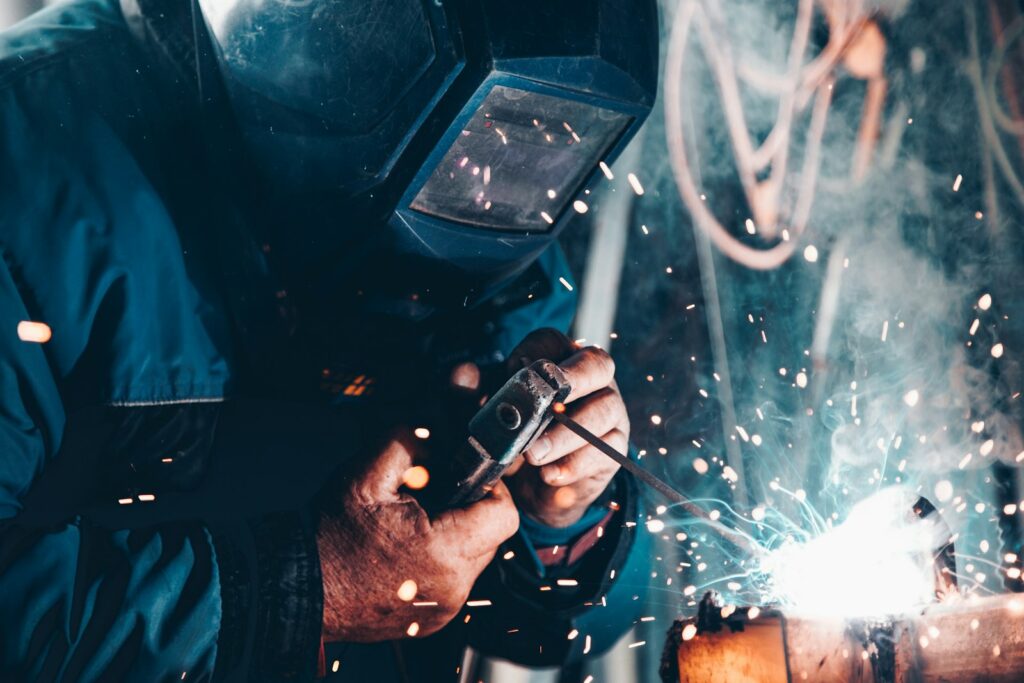
Welder working on a steel part with sparks flying

Manganese steel is the standard material for crusher jaw plates, mantles and many other high-impact wear parts. It is also one of the easiest steels to damage with a welding torch. A repair done the wrong way can leave a part more brittle than the one you started with.

This guide explains why heat is a problem for this alloy, the basic rules that welding guidance for it follows, and how to decide whether a worn part is worth repairing or should simply be replaced. We make manganese steel castings; we do not present this as a substitute for a qualified welding procedure.

Why Manganese Steel Reacts Badly to Heat

Austenitic manganese steel, often called Hadfield steel, is produced by heating the casting above about 1000 °C and quenching it in water. This locks the structure in a tough, soft state of roughly 200 HB. In service, impact and pressure work-harden the surface to around 500 HB while the core stays tough. That combination is why it lasts in a crusher.

If the metal is held at a high temperature for long, carbides form at the grain boundaries and the toughness drops. The part can then crack under the same impact it handled before. Heat from welding, and especially from torch cutting, can cause exactly this in the zone around the work.

Basic Rules for Welding Manganese Steel

Published guidance from filler metal makers, such as the datasheets from Lincoln Electric, points to the same handful of rules:

  • Use the right filler: an austenitic manganese or suitable stainless electrode, not ordinary mild steel rod.
  • Keep the part cool: no preheating is normally used, and the interpass temperature is kept low, around 260 °C (500 °F) at most.
  • Use short stringer beads: small beads let heat escape instead of soaking into the casting.
  • Remove the work-hardened layer: grind back to sound metal before building up.
  • Avoid torch cutting: cutting with heat damages a wide zone. Use grinding or air carbon arc with care.

Always follow the electrode maker’s datasheet and a qualified procedure for the actual job.

Part too worn to repair?

Send a photo and the machine. We quote a replacement casting.

Chat on WhatsApp

Repair or Replace: A Quick Comparison

SituationUsually better to
Small surface wear or a chipped edgeRepair, if a qualified welder is available
Cracks running through the sectionReplace
Part worn thin or out of shape so it no longer seatsReplace
Repeated repairs on the same partReplace
Safety critical or high load partReplace

When Replacement Is the Faster Option

A repair needs the right filler, a skilled welder and careful heat control, and the result is still a weld in a heat-sensitive alloy. A new casting is heat treated as a whole, so the structure is consistent through the part.

  • Grades: we cast Mn13 and Mn18 wear parts. See Mn13 vs Mn18 jaw plates.
  • Quality control: heat treatment is done in house and hardness is tested on every batch.
  • Timing: lead time is around 30 days for made-to-order parts.

For the full replacement cycle, read how often to replace crusher wear parts.

Checks Before You Decide to Repair

Manganese steel is sensitive to heat, so a repair needs a controlled procedure. Before choosing it, check:

  • Where the crack is and how deep it goes.
  • How much thickness is left in the part.
  • Whether a welder with a manganese steel procedure is available.
  • How long the repair will take against the lead time for a new part.

When Replacement Is the Safer Choice

Replace instead of repairing when the part has through-cracks, heavy section loss, or has already been repaired more than once, and for parts that affect safety. A repair that fails in service costs more than the part. See Buying Custom Cast Wear Parts in Zambia: Lead Times, MOQs & What to Expect for ordering a replacement and the Jaw Crusher Plates for jaw plates.

Frequently Asked Questions

No. Ordinary mild steel rod gives a brittle, poorly bonded joint. Manganese steel needs a suitable austenitic filler and controlled heat input.

A common field check is that austenitic manganese steel is generally non-magnetic when new, while ordinary steel is magnetic. Work hardening can make the surface slightly magnetic, so confirm with the supplier or a chemical test.

Yes. Send the part number, a drawing, or the worn part with measurements and we will quote a casting in the grade that suits your duty.

Need a Replacement Instead of a Repair?

Send us the part number or photos with measurements and we will quote a new casting.